Updated November 2026. Tabarca is the only inhabited island in the Valencian Community and a rare case in the Mediterranean: a fortified town built in one go, in the 18th century, for a group of families of Genoese origin. Here is its story in brief.
A pirate hideout off Santa Pola
The island, formerly known as Isla Plana or Isla de Santa Pola, lies about 3 nautical miles off Cape Santa Pola and forms a small archipelago with the islets of La Cantera, La Galera and La Nao. For centuries it was uninhabited and used as a hideout by the Barbary corsairs who raided the Alicante coast. That is why, in the 18th century, the Crown decided to fortify and settle it.
The Tabarquinos: from Tabarka to Nueva Tabarca
The first inhabitants came from Tabarka, a small island off the coast of Tunisia where, since the 16th century, a colony of families from Pegli (Genoa) lived mainly from coral fishing. In 1741 the island was taken by the Bey of Tunis and many of its inhabitants ended up as captives in Algiers.
King Charles III paid their ransom and in 1769–1770 settled them on the island near Alicante, which was renamed Nueva Tabarca. Surnames from that origin are still common in the area, such as Parodi, Ruso, Chacopino and Luchoro.
An 18th-century fortified town
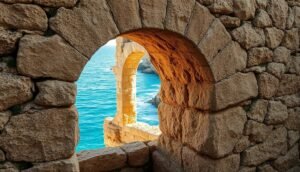
- The walls and the town’s grid layout, designed by the military engineer Fernando Méndez de Ras. Gates such as the Puerta de Levante, also called San Rafael, still stand.
- The Church of San Pedro y San Pablo, from the 18th century, inside the walls.
- The Governor’s House (Casa del Gobernador), residence of the military authority, now a hotel.
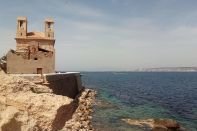
- The San José Tower, outside the walls, used as a state prison in the 19th century.
The whole site is protected as a Property of Cultural Interest (BIC), and Alicante City Council, to which the island belongs, is processing a Special Plan to conserve it.
Fishing, the almadraba and depopulation
Throughout the 19th century and much of the 20th, island life revolved around small-scale fishing and the almadraba, the traditional method of catching tuna. The old almadraba warehouse now houses the Nueva Tabarca Museum. As fishing declined, many families moved to Alicante and Santa Pola, and the permanent population shrank to a few dozen people.
Spain’s first marine reserve
In 1986 the waters around Tabarca became Spain’s first marine reserve. Protection allowed the Posidonia meadows and marine life to recover and turned the island into one of the best places on Spain’s Mediterranean coast for snorkelling and diving.
Tabarca today
Today Tabarca lives from day-trip tourism and small-scale fishing. Its inhabitants are called tabarquinos; find out more in who lives on Tabarca. If you are planning a visit, start with our guide on how to get to the island.